
DFSA AI survey: Generative AI adoption nearly tripled within the DIFC in last 12 months
The Dubai Financial Services Authority (DFSA), the independent regulator of the Dubai International Financial Centre (DIFC) conducted its second Artificial Intelligence (AI) survey in 2025, following its inaugural study in 2024, This report showcases its findings with comparative insights from the 2024 edition.
Key Findings:
-
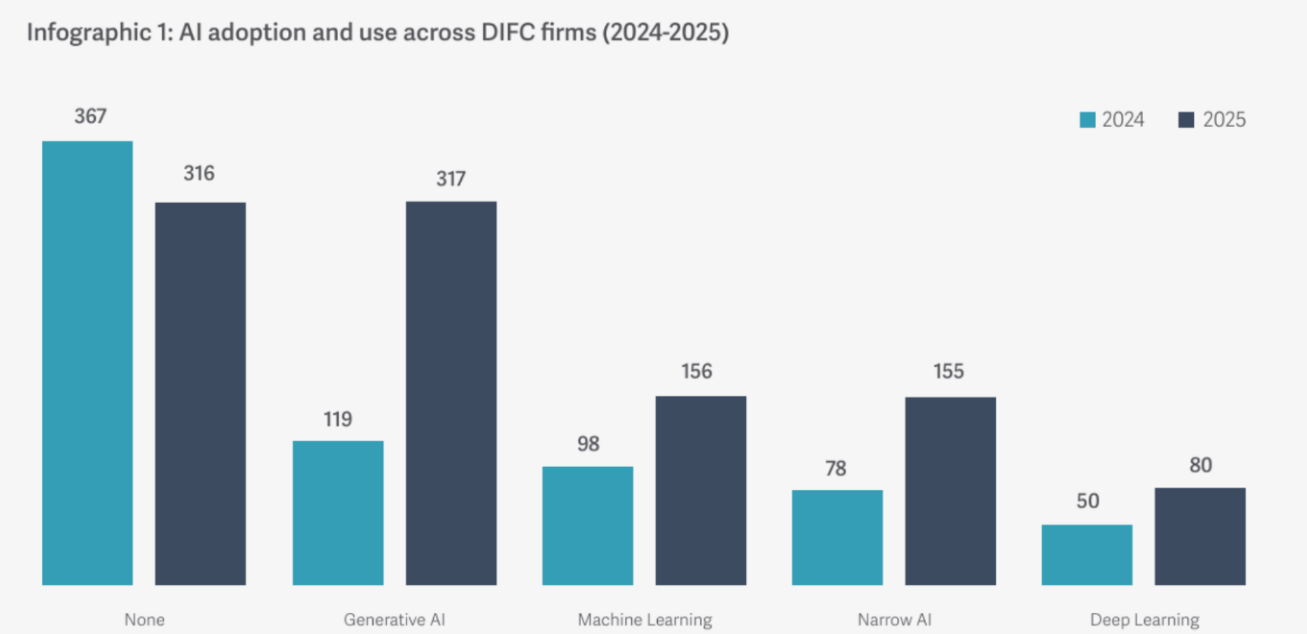
AI integration within DFSA Authorised Firms has accelerated rapidly: 52% of firms now use AI, up from 33% in 2024 with growth particularly pronounced in the adoption of Generative AI (GenAi) which has nearly tripled in the last 12 months (+166%).
-
Momentum continues to build: 60% of firms expect to increase their use of AI over the next 12 months, and 75% over the next three years signalling that AI is on track to become a core operational component of financial services within the DIFC.
-
Governance practices continue to develop: While 60% of firms have some form of governance structure for AI, 21% still lack clear accountability or oversight mechanisms, even in cases where AI use is critical to business operations.
-
Firms are calling for greater regulatory clarity and guidance: on AI governance, ethical use, and supervisory expectations. Harmonisation of regulatory expectations across the UAE financial sector was also a request from firms.
Shift in Market
The survey, conducted in June 2025, captured data from 661 Authorised Firms (88% participation rate) operating across Banking, Capital Markets, Wealth & Asset Management, and Fintech providing an insight into how AI is being adopted and governed within the financial services sector in the DIFC. The findings reflect a significant shift in the market, with most firms now integrating AI in at least one area of their operations and a clear majority planning further AI deployment, with expected continued adoption over the next 12 months.
Importance of Responsible Adoption
The DFSA emphasised that, while the pace of innovation is welcome, it must be underpinned by effective governance and oversight, ethical use of data, and sound risk management practices. The regulator continues to engage closely with the industry to develop guidance and frameworks for responsible AI adoption.
Divergence of AI application
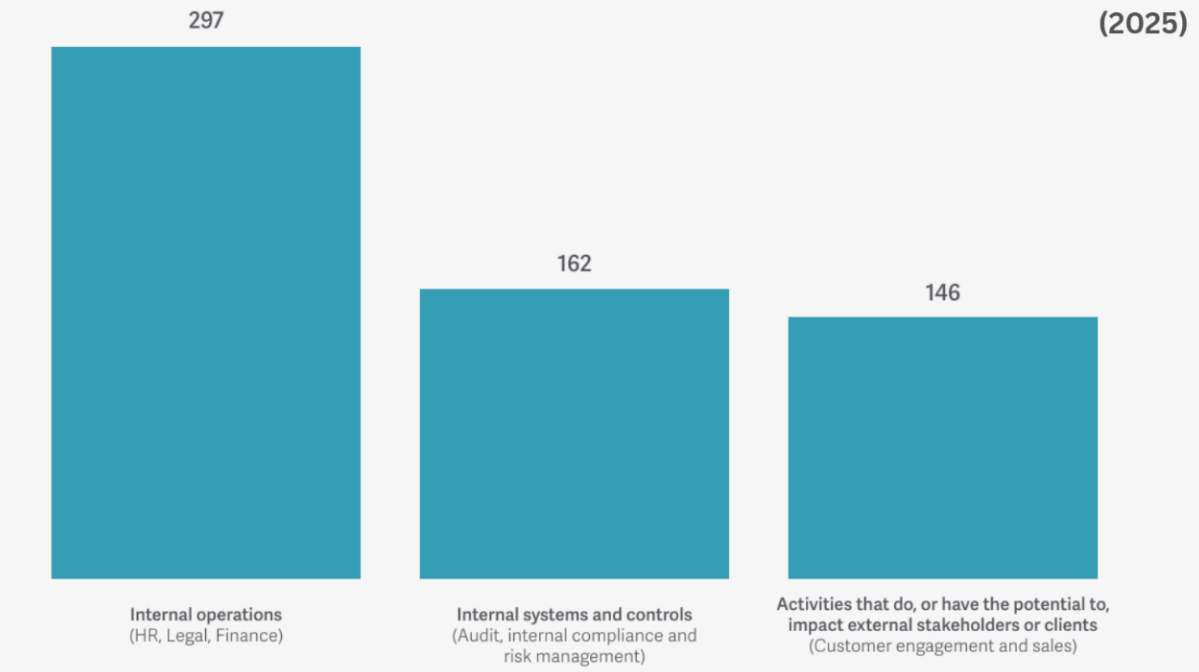
The survey results also underscore a cautious and controlled approach to deployment. Many firms continue to prioritise their use of AI on internal functions and processes, rather than external or customer-facing applications. This caution is reflected in the divergence of AI applications in use, as well as the need to build experience and develop appropriate governance frameworks.
Stages of AI deployment in financial firms
Most firms remain at relatively early stages of AI deployment focusing on proof-of-concept initiatives or pilot programmes rather than full scale implementation. However, the level of maturity has continued to evolve.
AI adoption and types of applications
AI adoption among DIFC firms rose from 33% in 2024 to 52% in 2025. This translates to 345 firms now actively using AI, compared with 177 a year earlier. The adoption of Generative AI (GenAI) saw the biggest increase, up 166%, followed by Narrow AI with 99%, while Deep Learning and Machine Learning both saw usage climb by more than 60%. This growth broadly mirrors global trends in the financial sector, as we see GenAI becoming more accessible and serving as a catalyst for broader AI integration across business functions.
How are firms utilising AI?
Leadership Insight
Justin Baldacchino, Managing Director, Supervision, of the DFSA, said: "The DIFC’s financial services ecosystem is embracing AI at pace. While AI adoption remains at a nascent stage for many firms, there is growing recognition of its strategic potential to enhance organisation-wide performance, from operational efficiency and regulatory compliance to customer engagement and sales. Our priority at the DFSA is to balance innovation with integrity ensuring that when firms harness AI’s potential, they do so within frameworks that protect customers, manage risk, and uphold market confidence. It is therefore important that governance frameworks evolve in parallel, with clear accountability and oversight at every stage of adoption.”
Looking into the future
The DFSA plans on following a risk-based approach to regulation, ensuring that its oversight remains proportionate and responsive to emerging risks without imposing unnecessary burden on firms. In the months ahead, the Authority will continue to engage actively with firms and other financial regulators in the UAE and globally to chart a path forward that reinforces their commitment to balance the enabling of responsible innovation with safeguarding financial stability and investor protection.
This blog is for informational purposes only and does not constitute legal or regulatory advice. The information provided has been compiled from publicly available sources, and while we have made every effort to ensure its accuracy and relevance at the time of publication, we do not guarantee its completeness or applicability to specific situations. Readers are encouraged to seek independent professional advice before making any decisions based on the content herein.
 Zubin Muriya is a seasoned Governance, Risk, and Compliance (GRC) professional with over two decades of cross-jurisdictional experience in banking regulatory compliance, financial crime risk management, corporate governance framework, and audit advisory. His work across India and the GCC (UAE, Qatar, Bahrain) reflects a career rooted in regulatory rigor and operational integrity.